Skip to content

Building a Unified Revenue Engine

To deliver marketing-led growth, each stage of go-to-market execution must be optimised using a data-driven approach.

By optimising each stage of the end-to-end funnel process, sales cycles are accelerated, buyers are engaged and pipeline value is increased.

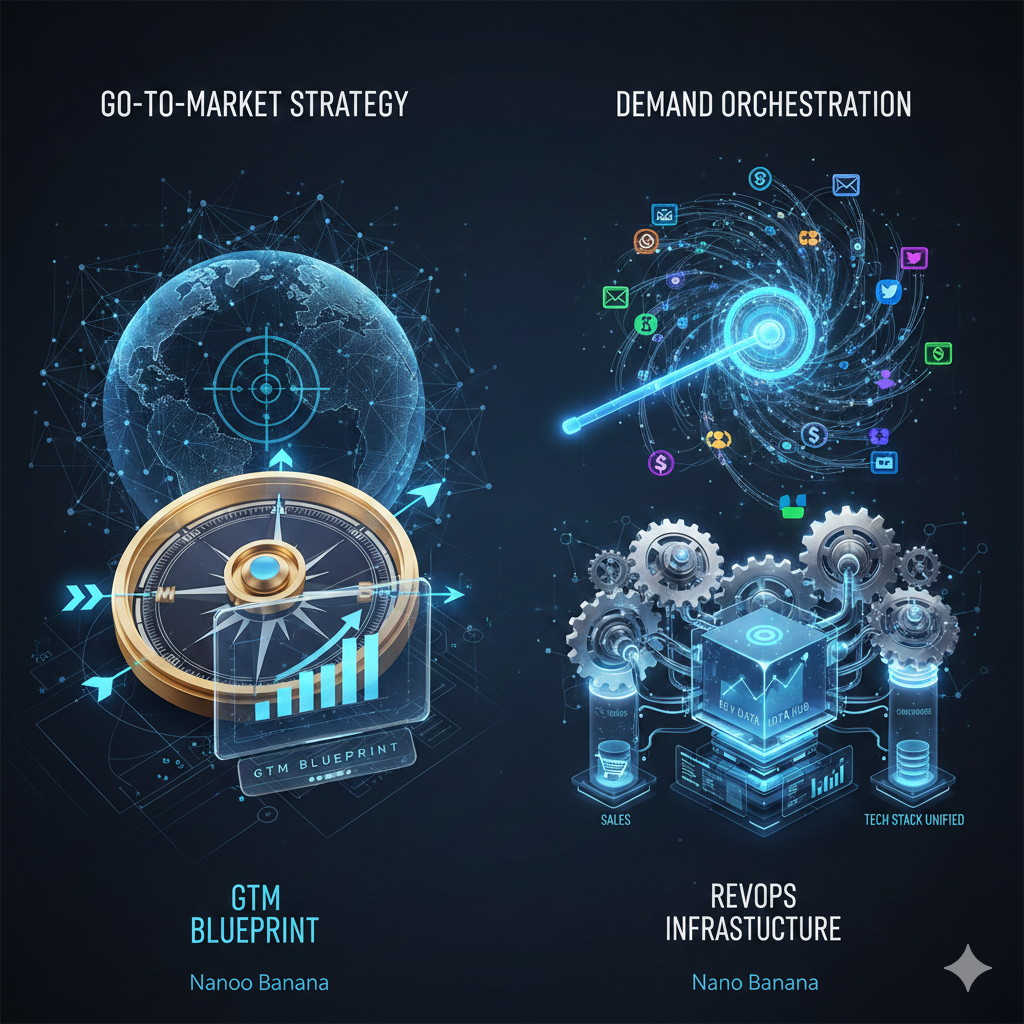
The graphic demonstrates the relationship between business growth objectives and the customer lifecycle, from demand creation through to contract, delivery and retention. Mouse over the graphic to access the key activities that take place at each stage.

Marketing Strategy

  • Go-to-Market (GTM) Strategy: This is your comprehensive blueprint for delivering a unique value proposition to your customers and achieving a competitive advantage. Rather than just a “product launch,” a B2B GTM strategy defines exactly which market segments to target, what messaging, content and pricing models will drive adoption, and which distribution channels will most effectively reach your Ideal Customer Profile (ICP).

  • Demand Orchestration: Think of this as the “conductor” of your marketing efforts. Demand orchestration moves beyond simple lead generation by coordinating data, content, and touchpoints across various channels (email, social, ads, and web). It ensures that your brand delivers a personalized, seamless experience to a prospect throughout their entire buying journey, preventing fragmented or repetitive messaging.

  • RevOps (Revenue Operations) Infrastructure: This is the “plumbing” and technical stack that connects Marketing, Sales, and Customer Success. A robust RevOps infrastructure eliminates data silos by integrating tools like your CRM, automation platforms, and analytics dashboards. Its primary goal is to provide a “single source of truth,” allowing your team to make data-driven decisions based on accurate revenue forecasting and performance metrics

    Discover more…

Mastering Your Go-to-Market (GTM) Strategy

Developing a winning Go-to-Market strategy is the foundation of sustainable B2B SaaS growth. The “how” begins with a deep dive into market segmentation and the refinement of your Ideal Customer Profile (ICP). By conducting rigorous competitive analysis and buyer persona research, you can align your product-market fit with the specific pain points of your target audience.

A successful GTM framework focuses on optimizing your value proposition and pricing strategy to reduce Customer Acquisition Cost (CAC) while increasing market penetration. Whether you are utilizing a product-led growth (PLG) model or a high-touch sales-led approach, your GTM plan acts as the strategic roadmap for demand generation.

By synchronizing your sales enablement tools with localized marketing tactics, you ensure that your brand enters the ecosystem with maximum impact, capturing market share and establishing a clear competitive advantage in a crowded digital landscape.


Optimizing Demand Orchestration

Demand orchestration is the process of converting raw lead generation into a sophisticated, omnichannel marketing machine. The “how” involves the programmatic coordination of content marketing, account-based marketing (ABM), and lead nurturing across the entire marketing funnel.

By leveraging intent data and predictive analytics, marketing teams can automate the delivery of personalized messages at the exact moment a prospect is ready to buy. This prevents the “leaky bucket” syndrome by ensuring that marketing-qualified leads (MQLs) are properly scored and transitioned to sales-qualified leads (SQLs) without friction. Orchestration focuses on the buyer’s journey, utilizing marketing automation to trigger touchpoints based on user behavior.

This holistic approach optimizes your conversion rate and maximizes Return on Ad Spend (ROAS) by eliminating redundant messaging. By centering your efforts on customer engagement and brand consistency, you build a scalable pipeline that delivers high-quality opportunities to your sales team.

Building A Robust RevOps Infrastructure

The “how” of RevOps infrastructure lies in the seamless integration of your tech stack to eliminate data silos and drive operational efficiency. A modern Revenue Operations framework centers on a unified CRM platform that acts as the single source of truth for Marketing, Sales, and Customer Success.

By implementing automated data hygiene protocols and workflow automation, RevOps ensures that every department is working toward shared Key Performance Indicators (KPIs). This infrastructure enables precise revenue forecasting, pipeline visibility, and attribution modeling, allowing leadership to see exactly which touchpoints drive Annual Recurring Revenue (ARR). Beyond software, it involves the standardization of sales processes and customer success handoffs to improve Net Revenue Retention (NRR).

By leveraging data-driven insights and full-funnel analytics, a strong RevOps foundation provides the transparency needed to scale resources effectively, mitigate churn, and optimize the entire customer lifecycle for long-term profitability.

Campaign Management

‘Always On’ Digital Campaigns with Measurable Results

Generating qualified leads for Sales to follow up on with genuine targets, requires effective tactics for lead acquisition, conversion and nurture with agreed handover points.

We can help establish always on, digital inbound lead strategies, performance-optimised to minimise CPA and maximise funnel contribution.

We can set up channels, create content, manage tracking or handle campaign execution with a fully-managed service – delivering you sales ready leads that meet agreed criteria.

We always recommend starting with the end in mind so we suggest our 10-point plan is implemented in parallel with funnel marketing campaigns.

Marketing Operations

Enabling Agile Sales & Marketing Teams to Achieve Consistent Performance

Together, your website, your customer relationship management system (CRM) and your marketing automation platform (MAP) are the bedrock of your customer data collection activity.

We help to ensure that your sales and marketing teams are supported with the right tools to do their job and that managers have the needed insight to make investment decisions. An integrated approach is recommended.

Related Blogs

file-_2_-pbqtpdg82dp325648pkmes5rqjmd7r3ggu54714v02

The ‘Silver Bullet’ Syndrome in B2B Marketing

file-_1_-pbqtpdg82dp325648pkmes5rqjmd7r3ggu54714v02

A Beginner's Guide to Successful B2B Email Marketi…

file-pbqtpdg82dp325648pkmes5rqjmd7r3ggu54714v02

10 of the Best Digital Marketing Strategies for Start…